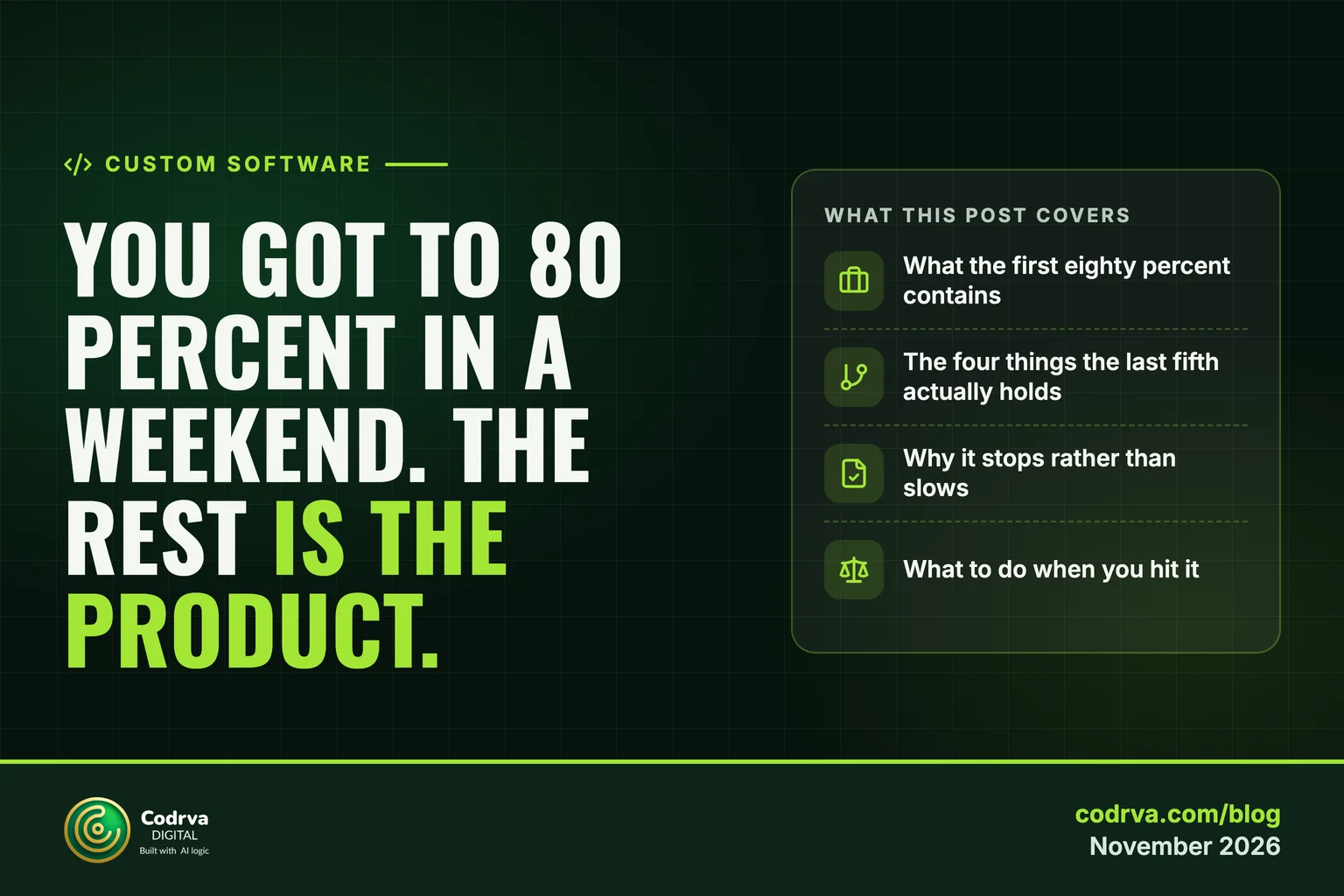
You Got to 80 Percent in a Weekend. The Rest Is the Product.
The demo works, the screens are right, and your friends are impressed. What is left is not twenty percent of the work, it is the twenty percent that decides whether anyone can rely on it.
Insights, tutorials, and industry updates from our team of developers and AI specialists. Stay ahead of the curve with the latest in technology and development practices.

The demo works, the screens are right, and your friends are impressed. What is left is not twenty percent of the work, it is the twenty percent that decides whether anyone can rely on it.

The gap between what was measured and what was felt is the finding. Not the direction of the result, which the study itself is careful to limit.

The case for replacing an old system was never really about the code. It was that nobody could work out what it did, and that specific problem has become considerably cheaper to solve.

Teams that cut their estimates because coding got faster are overrunning by roughly the amount they cut. The fast part was never the part that made estimates wrong.

Code review was designed as a second opinion. It is increasingly a first opinion, and the habits built for the first job do not do the second one.

Nothing was deployed. No library moved. The lockfile is identical. And a feature that worked last Tuesday now behaves differently, because the thing it calls is not in the lockfile.

A new starter learns your codebase once and remembers it for years. The thing writing most of your code learns it every morning and forgets by evening.

A defect that fails loudly costs minutes. A defect that works correctly on every case anyone thought to check costs a quarter. The second kind has four recognisable shapes.

The people who use these tools most are the people trusting them least, and they are not being contrarian. They have simply been closest to the failure mode for longest.

The vulnerability disclosed on 1 September needs one thing to work: a project folder that arrives as files with its hidden git directory intact. That is precisely how every agency in the world receives client code.

The system runs. It passed testing and customers use it daily. Then something fails at an awkward hour, and the person looking at the code discovers that nobody ever understood this part, including whoever shipped it.

Roughly a third of organisations declined at least one software purchase this year because they could build the equivalent internally. The interesting part is not that they could. It is which purchases they declined, and what happened next.
Get the latest posts delivered right to your inbox.
The demo works, the screens are right, and your friends are impressed. What is l...
Nov 5, 2026
The gap between what was measured and what was felt is the finding. Not the dire...
Nov 3, 2026
The case for replacing an old system was never really about the code. It was tha...
Nov 1, 2026
Teams that cut their estimates because coding got faster are overrunning by roug...
Oct 27, 2026
Code review was designed as a second opinion. It is increasingly a first opinion...
Oct 23, 2026
Nothing was deployed. No library moved. The lockfile is identical. And a feature...
Oct 19, 2026
A new starter learns your codebase once and remembers it for years. The thing wr...
Oct 15, 2026
A defect that fails loudly costs minutes. A defect that works correctly on every...
Oct 12, 2026
The people who use these tools most are the people trusting them least, and they...
Oct 8, 2026
The vulnerability disclosed on 1 September needs one thing to work: a project fo...
Oct 3, 2026