
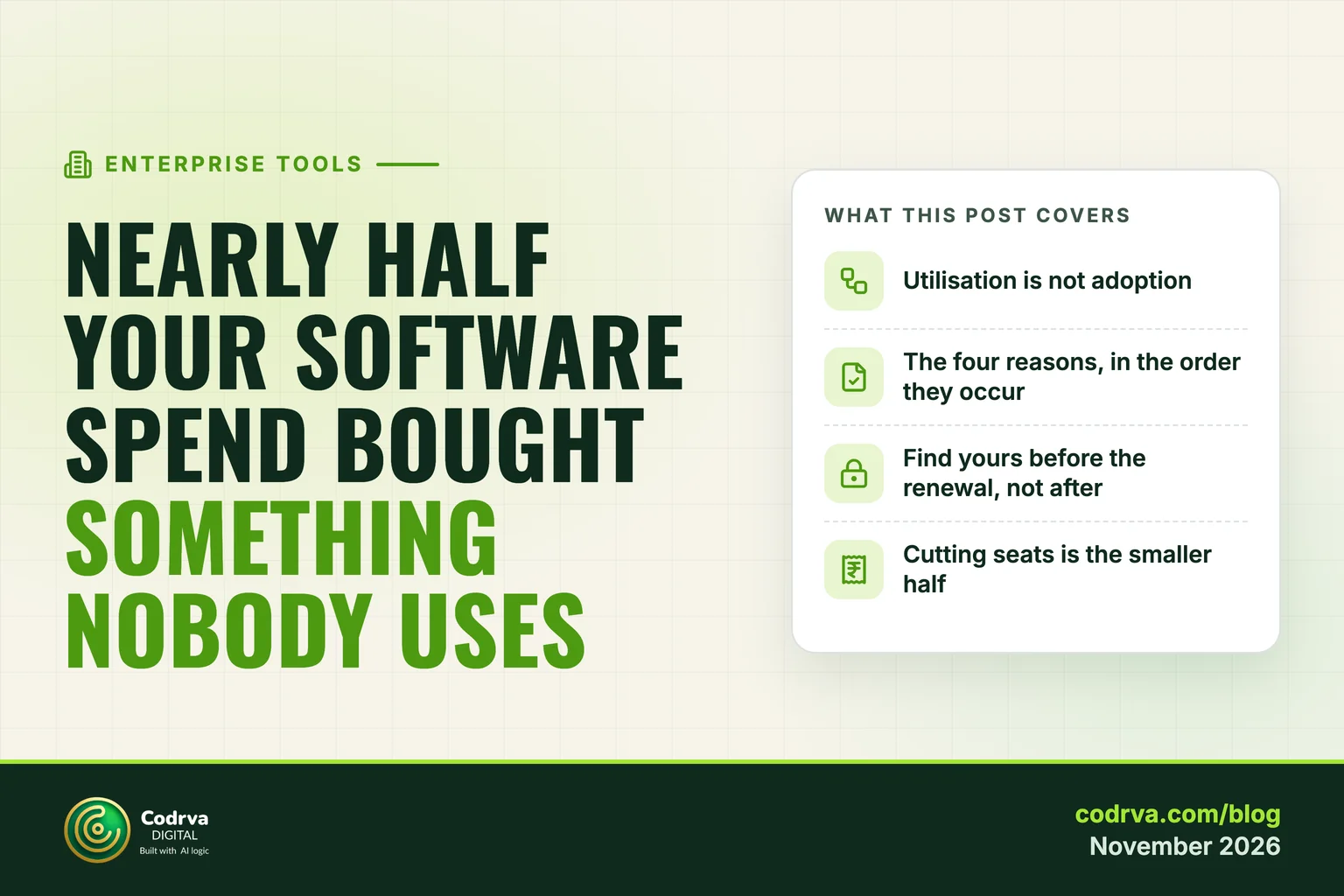
WalkMe's State of Digital Adoption 2026 report puts nearly 40 percent of technology spend as underperforming because people could not or did not use the tools they were given. Not because the tools were wrong, and not because procurement failed. Because the last step, somebody actually using the thing, was nobody's job.
That figure is uncomfortable in a way most software waste is not. Unused licences are visible and get cancelled. This is different: the licences are used just enough to look alive, by a fraction of the people the business case counted.
Utilisation is not adoption
The number most organisations have is licence utilisation, and it flatters heavily.
A licence counts as used if somebody logged in. That includes the person who signs in once a quarter to retrieve a file, the account attached to an integration, and the manager who opens it before a review. All three appear identical to a seat count.
What you need is narrower: people who performed the work the tool was bought for, in the last week. That number is frequently a third of the licence count, and the gap between them is the size of the problem.
We ask for both figures at the start of a review and the difference is usually the most persuasive slide in the whole conversation, because nobody has to be convinced of anything. It is their own data.
The four reasons, in the order they occur
Underuse has a small number of causes and they are diagnosable.
The tool solved a problem the buyer had rather than one the user has. This is the most common and the hardest to admit, because it means the requirement came from the wrong direction.
It is slower than the workaround. If the spreadsheet takes four minutes and the system takes eleven, people will use the spreadsheet regardless of policy, and they are behaving rationally.
It arrived without anyone owning the rollout past launch week. Training happened, the project closed, and nobody was accountable for whether behaviour changed in month three.
Or it was configured for a process that has since changed, so the fields, stages and approvals describe how the business worked two reorganisations ago.
We find the second reason more often than the first, and it is the one nobody reports upward. Somebody timed both routes, the sanctioned one lost, and the finding stayed inside the team because saying it out loud sounds like an excuse.
The unapproved tool that results is worth treating as a requirement rather than a violation, which we went through in when a personal script becomes business critical.
Find yours before the renewal, not after
The practical work is a short audit and the timing matters more than the depth.
List your top ten tools by cost. For each, get the count of people doing the core task weekly, and compare it against the seats you pay for. Then ask three people in the relevant team what they actually use for that task.
That last question is the one that produces the surprises, because it surfaces the workaround. When somebody names a spreadsheet, a shared document or a tool nobody approved, you have found both the problem and the requirement at once.
Do this a quarter before renewal rather than a fortnight. A fortnight leaves you with two options, renew or scramble. A quarter leaves room to fix adoption, renegotiate the seat count, or migrate deliberately.
Cutting seats is the smaller half
The obvious response is to reduce licences to match reality, and it is worth doing.
It is also the less valuable half. Reducing seats saves the licence fee. Making the tool genuinely used delivers the benefit the business case promised, which was always the larger number.
So run both: right-size the contract, and pick one tool where the gap is largest and fix it properly. Fixing one thing well teaches you more about why adoption fails in your organisation than trimming ten contracts does.
The pattern behind most of these failures is the same one that leaves developer portals unopened, which we went through in the portal almost everyone built and a tenth use.
Make adoption somebody's number
The structural fix is unglamorous and it is the only durable one.
Every significant tool needs a named owner with an adoption target, reviewed at the same cadence as anything else that costs money. Not the person who ran the procurement, and not a committee.
Without that, adoption is everyone's concern and nobody's metric, which is precisely the condition that produces the 40 percent. With it, the tool either gets used or gets killed early, and both outcomes are better than a licence quietly renewing for three years.
Give the owner the authority to change the configuration, too. An owner accountable for adoption who cannot remove a required field or simplify a workflow has responsibility without the means, which is a familiar way to make somebody quietly stop caring.
Buy less, and buy later
The preventative version changes how the next purchase happens.
Run a genuine pilot with the people who will use it, doing real work, before signing for the organisation. Not a demonstration and not a trial by the evaluating committee. If a team of eight will not adopt it voluntarily over a month, eight hundred will not adopt it under instruction.
And buy fewer seats than you expect to need. Adding seats is trivial and removing them is a renegotiation, so the asymmetry should shape the initial order rather than the vendor's suggestion.
Our enterprise tools work now begins with the utilisation gap on what is already owned, because the cheapest capability available to most organisations is the software they are already paying for.
Frequently Asked Questions
What should we measure instead of licence utilisation?
People performing the core task the tool was bought for, weekly. A login counts somebody retrieving a file once a quarter, an integration account and a manager checking a report as identical usage.
When should we audit?
A quarter before renewal. A fortnight leaves you renewing or scrambling. A quarter leaves room to fix adoption, cut the seat count, or migrate on your own timetable.
What question reveals the most?
Asking three people in the team what they actually use for that task. When the answer is a spreadsheet or an unapproved tool, you have found the problem and the real requirement together.
Should we just cut unused seats?
Do it, and treat it as the smaller half. Cutting seats saves the fee; making one badly adopted tool genuinely useful delivers the benefit the business case actually promised.
Who should own adoption?
One named person with a target, reviewed like any other cost, and with authority to change the configuration. Responsibility without the ability to remove a required field is not ownership.
How do we avoid this on the next purchase?
Pilot with the people who will use it doing real work, not a demonstration. If eight will not adopt it voluntarily in a month, eight hundred will not adopt it under instruction.
How many seats should we buy initially?
Fewer than you expect to need. Adding seats is trivial and removing them is a renegotiation, so let the asymmetry shape the order rather than the vendor's recommendation.
Is this really a people problem rather than a tool problem?
Usually, though not always. If the tool is slower than the workaround it replaced, that is a genuine tool problem and no amount of ownership fixes it. Check the timing before blaming behaviour.
Talk to our team if you are about to renew software and nobody can say how many people use it weekly.