
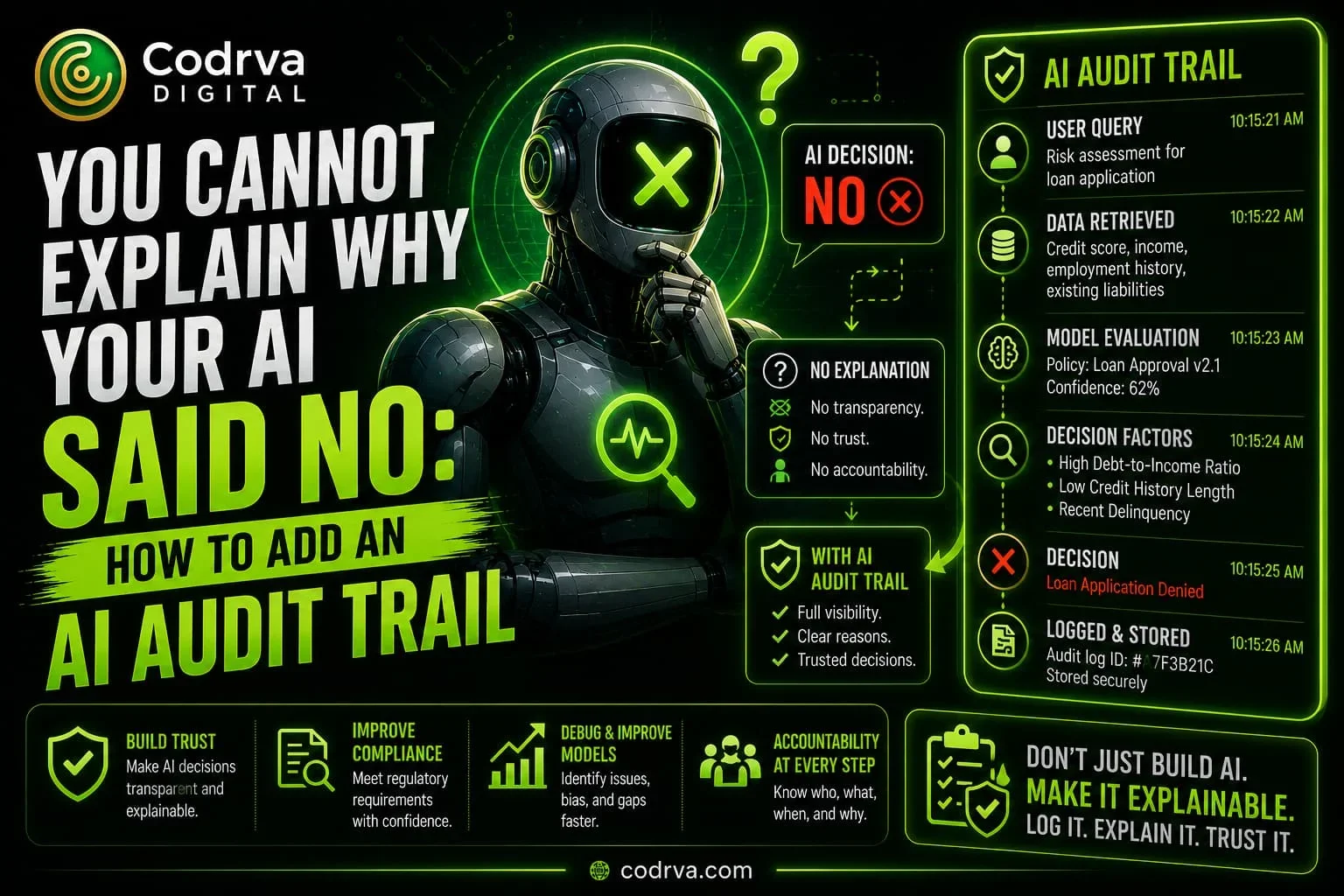
A customer is declined and asks why. The support agent escalates, an analyst opens the system, and the only available answer is that the model scored them below a threshold. Nobody can say which factors mattered, what the system saw, or whether the same application would be declined tomorrow. Without an AI audit trail, that question has no answer, and the question always eventually gets asked.
This is one of the three blockers that stops AI projects reaching production, alongside evaluation gaps and reliability. Governance friction is cited by around 57 percent of leaders as a reason systems stall. The technology works in testing and nobody will authorise it, because no one can defend a decision it makes.
What an AI audit trail actually needs to capture
Logging that the system ran is not an AI audit trail. Reconstructing a decision months later requires capturing enough to reproduce it, which is more than most teams record by default:
- The exact inputs. Everything the system saw, including retrieved documents and data pulled from other systems, not just the user's request.
- Model and version. Which model, which version, and which prompt or configuration. Behaviour changes between versions, so a decision is only reproducible if you know what produced it.
- The output and any confidence signals. The raw response before any post processing.
- Every rule that fired. Which validations, thresholds, and business rules applied, and what each concluded.
- Human involvement. Who reviewed it, what they saw, what they changed, and when.
- The final action. What the system actually did, which is often not identical to what the model returned.
The gap most teams discover late is retrieved context. If the decision drew on documents fetched at runtime and you did not store which ones, the decision is permanently unexplainable, because the corpus has changed since.
Explainability is not the same as interpretability
These get conflated and the distinction matters commercially. Interpretability means understanding how the model works internally, which for a large language model is largely unavailable to you.
Explainability means being able to say why this decision happened: what inputs were present, what rules applied, what the system produced, and what path led to the outcome. That is achievable, and it is what regulators, customers, and courts actually ask for.
So the goal is not opening the model. It is building a system whose decisions are accountable at the boundary, where you can show inputs, process, and outputs even though the middle is statistical. That framing makes the problem tractable rather than philosophical.
Read More - SaaS Product Engineering in 2026: From Idea Validation to Scalable Architecture
Design your AI audit trail in from the start
Retrofitting an AI audit trail is painful and often impossible, because the information you needed was never recorded. A few architectural choices make it straightforward:
- Separate judgement from action. Have the model produce a structured assessment, then let deterministic code decide what happens. The consequential step becomes ordinary reviewable logic.
- Require reasons in the output. Structured fields naming the factors, not a free text paragraph. Reasons you can query beat prose you have to read.
- Ground decisions in retrievable evidence. Store the source passages with the decision so a reviewer sees exactly what informed it.
- Version everything. Prompts, thresholds, and rules under version control, with the version recorded on each decision.
- Log before acting. Write the audit record as part of the transaction, not afterwards, so failures cannot produce unlogged actions.
- Keep the human review path visible. Record overrides and their reasons. Override patterns are the most valuable quality data you will get.
That first point does most of the work. A system where a model recommends and code decides is far easier to defend than one where the model acts directly, and it usually performs better because the rules encode knowledge the model does not have.
Override data is worth more than you think
Once humans can override decisions and you record why, you get something genuinely valuable: a continuous, free signal about where the system is weak.
Overrides cluster. A particular customer type, an edge case, a category where the model systematically misjudges. Those clusters are your next engineering priorities, identified by the people closest to the work rather than by guesswork in a planning meeting.
Teams that do not capture override reasons lose this entirely. Reviewers quietly correct the system every day, the same errors recur for months, and nobody has data showing the pattern. The cost is not the individual corrections, it is never learning from them.
The conversation that forces this to happen
Most teams do not build this because someone read a regulation. They build it after a specific meeting, and it is worth knowing what that meeting looks like so you can have it early and cheaply rather than late and expensively.
It usually starts with a single escalated case. A customer, an employee, or a partner disputes an outcome, and the dispute travels up until it reaches someone senior enough to ask the obvious question: on what basis did we make this decision. The engineering answer, that the model scored it below a threshold, is technically accurate and completely unusable in that room.
What happens next is predictable. Someone asks how many other decisions were made the same way, and nobody knows. Someone asks whether the system has been consistent over the past six months, and nobody can check, because the prompt changed twice and neither version was recorded. The conversation stops being about one customer and becomes about whether the system should be running at all.
Every one of those questions is answerable in minutes with a proper AI audit trail and unanswerable without one. The asymmetry is what makes this worth building before you need it, because the moment you need it is the moment it is too late to start collecting the data.
Read More - Custom CRM Development with AI: Building Sales, Marketing, and Support Intelligence
What this costs and why it is worth it
An AI audit trail is real engineering, not a checkbox. Storage grows quickly when you retain full inputs and retrieved context, retention policies have to be decided deliberately, and personal data creates deletion obligations that interact awkwardly with immutable logs. Budget for it as a component rather than a logging afterthought.
The return is that it unblocks deployment. Governance objections are among the top reasons systems never ship, so a project that can answer accountability questions in advance moves through approval instead of stalling in review for months. The AI audit trail is frequently the difference between a working prototype and a system in production.
There is a second return that is harder to quantify. When something does go wrong, and eventually it will, the organisation's response depends entirely on whether you can explain what happened. A team that can show inputs, versions, rules, and reviewers handles an incident as an engineering problem. A team that cannot handles it as a crisis of confidence in the whole programme, and that is usually where AI initiatives get quietly shut down.
If you are building automated decisioning that has to be defensible, our AI tools development team designs the logging and governance layer alongside the model, and our custom software team builds the systems around it. Related reading: stopping AI hallucinations, why pilots never reach production, and building AI enabled applications.
Frequently Asked Questions
What is an AI audit trail?
A record complete enough to reconstruct why an automated decision happened: the exact inputs including retrieved context, the model and version, the configuration, the raw output, every rule that fired, any human involvement, and the final action taken. Logging that the system ran is not sufficient, because it does not let anyone reproduce or challenge the outcome.
Do we legally need one?
It depends on jurisdiction and what the system decides, but the direction of travel is clear and regulations increasingly require meaningful information about automated decisions affecting people. Beyond compliance, the practical driver is usually commercial: enterprise customers, insurers, and internal risk teams ask these questions before approving deployment, regardless of statute.
Can we add an audit trail later?
Partially, and it is much harder than doing it upfront. You can start logging from today, but decisions already made remain unexplainable because the inputs and retrieved context were never captured. If a system is running without one, begin recording immediately rather than waiting for a redesign, since every day of delay adds permanently opaque decisions.
How long should we retain decision logs?
Long enough to cover the period in which a decision could reasonably be challenged, which is often years for financial or employment decisions. Balance that against storage cost and data protection obligations, and consider tiering: full context for a recent window, then a reduced record retained longer. Decide the policy deliberately rather than defaulting to keeping everything forever.
Does explainability hurt accuracy?
Usually not, and it often helps. Separating the model's assessment from the action taken by deterministic code tends to improve outcomes, because business rules encode constraints the model has no way to know. What it does cost is engineering time and some latency, which is a very different trade off from sacrificing quality.
What if the model cannot explain its own reasoning?
Do not rely on it to. Asking a model to explain itself produces a plausible narrative that may not reflect what actually drove the output. Real explainability comes from the surrounding system recording inputs, retrieved evidence, versions, and applied rules, which are facts rather than reconstructions.
Who should own the audit trail?
Engineering builds it, but the requirements should come from whoever answers when a decision is challenged, typically risk, legal, or compliance. Teams that let engineering define the requirements alone tend to log what is easy to capture rather than what someone will actually need to produce under scrutiny.
See also AI tools that deliver returns. Talk to our team about making automated decisions defensible.